I need to say something that might be controversial if you've been recruiting for a while.
Boolean search had its time. It was genuinely useful for like 20 years. But it's 2026 and we're still out here writing strings like it's a command line from the 90s.
If you've ever spent 30 minutes tweaking a Boolean string, ran it, got 400 garbage results, then tweaked it again... you already know what I'm talking about.
The Problem with Boolean (That Nobody Wants to Admit)
Boolean search works on exact keyword matching. AND, OR, NOT, quotes, parentheses. You're basically writing code to search for people.
Here's a real Boolean string a recruiter might write for a senior backend role:
("senior engineer" OR "staff engineer" OR "principal engineer") AND (Python OR Go OR Golang) AND (fintech OR payments OR "financial services") NOT (manager OR director OR VP OR "vice president")
Look at that thing. You need to know every possible job title variation. Every synonym. Every way someone might describe their role. And if you miss one? Those candidates just vanish from your results.
But the real problem is deeper than syntax. Boolean is fundamentally limited because it can only match keywords. It can't understand what those keywords mean in context.
The Boolean paradox
Make your string too broad and you drown in irrelevant results. Make it too narrow and you miss great candidates. There's almost never a sweet spot.
What Boolean Search Actually Misses
Let me give you some real scenarios where Boolean falls apart.
Career trajectory.You want someone who's been promoted at least once. Boolean literally cannot express this. It sees keywords, not career patterns.
Context.Someone's profile says "Python" but they used it once in a college project 8 years ago. Boolean treats that the same as someone with 7 years of production Python. Both match.
Title variations."Software Development Engineer" at Amazon is a senior IC role. But it doesn't contain the word "senior." Boolean misses it unless you add every single Amazon title variation to your string.
The vibe check."I want someone who's been at fast-growing startups, not big corp lifers." Try expressing that in Boolean. You can't. You'd have to list every startup by name.
Boolean vs Natural Language: Side by Side
Let me show you the same search intent expressed both ways.
Example 1: Senior Backend Engineer
Boolean:
("senior engineer" OR "staff engineer") AND (Python OR Go) AND (fintech OR payments) NOT manager
Natural language:
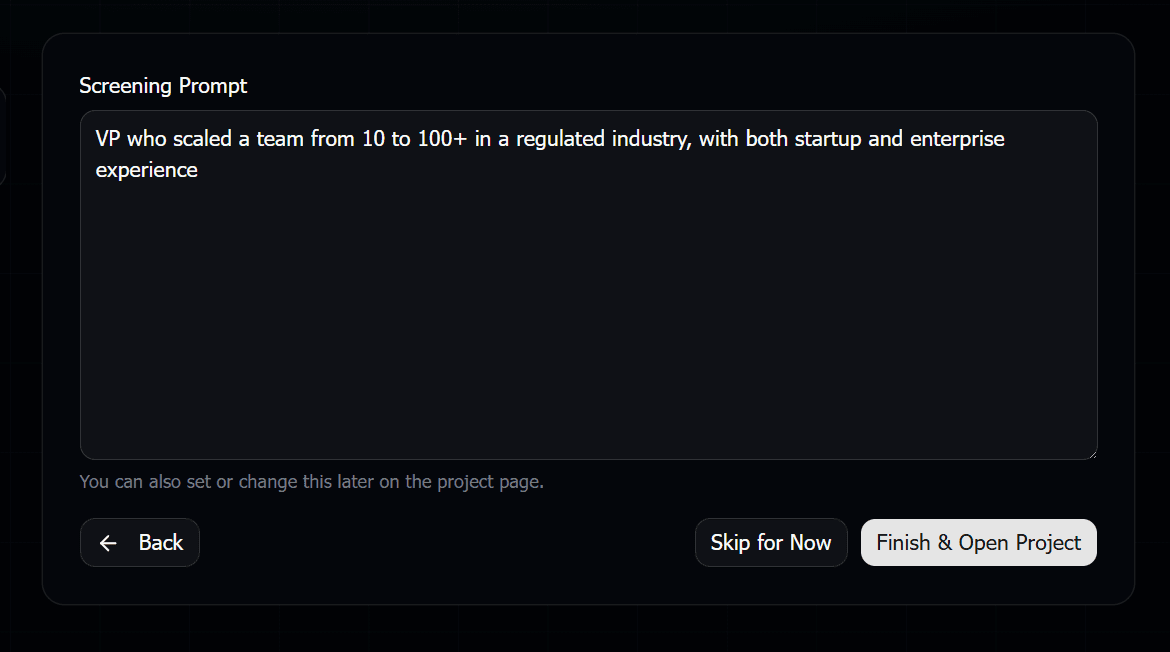
Senior backend engineers with Python or Go experience in fintech. Want ICs, not managers.
Example 2: Sales Leader for SaaS
Boolean:
("VP Sales" OR "Head of Sales" OR "Sales Director" OR "CRO" OR "Chief Revenue Officer") AND (SaaS OR "software as a service" OR B2B) AND ("Series A" OR "Series B" OR startup OR "early stage") NOT (enterprise OR Fortune)
Natural language:
Sales leaders who've built teams at early-stage SaaS startups (Series A or B). Should have taken a company from $1M to $10M+ ARR. Not interested in people who've only worked at large enterprises.
See the difference? The natural language version can express things like "built teams" and "taken a company from $1M to $10M+ ARR." Try doing that with AND/OR/NOT.
Example 3: Product Designer with Startup DNA
Boolean:
("product designer" OR "UX designer" OR "UI/UX designer") AND (Figma OR Sketch) AND (startup OR "early-stage") AND ("design system" OR "0 to 1")
Natural language:
Product designers who've built design systems from scratch at startups. Bonus if they've done 0-to-1 product work. I want someone who can own the whole design process, not someone who just pushes pixels on an existing system.
The key difference
Boolean search matches keywords. Natural language screening understands intent. It reads the actual career story and evaluates whether someone fits what you described, even if they don't use the exact words you did.
How Natural Language Screening Actually Works
So what happens under the hood when you write a natural language prompt instead of a Boolean string?
The AI reads each candidate's full profile. Their job titles, the companies, how long they stayed, what they did, their skills. Then it evaluates all of that against your description.
It's not doing keyword matching. It actually understands that "Software Development Engineer II at Amazon" is a mid-to-senior IC role. It understands that 3 jobs in 3 years might be a red flag. It can see that someone transitioned from finance to engineering, which might be exactly what you want for a fintech role.
You describe the ideal candidate
In your own words. Any criteria, any nuance. Career patterns, company types, red flags, bonus points. Whatever matters to you.
AI reads every profile
Not scanning for keywords. Actually reading the full career story and understanding context, trajectory, and relevance.
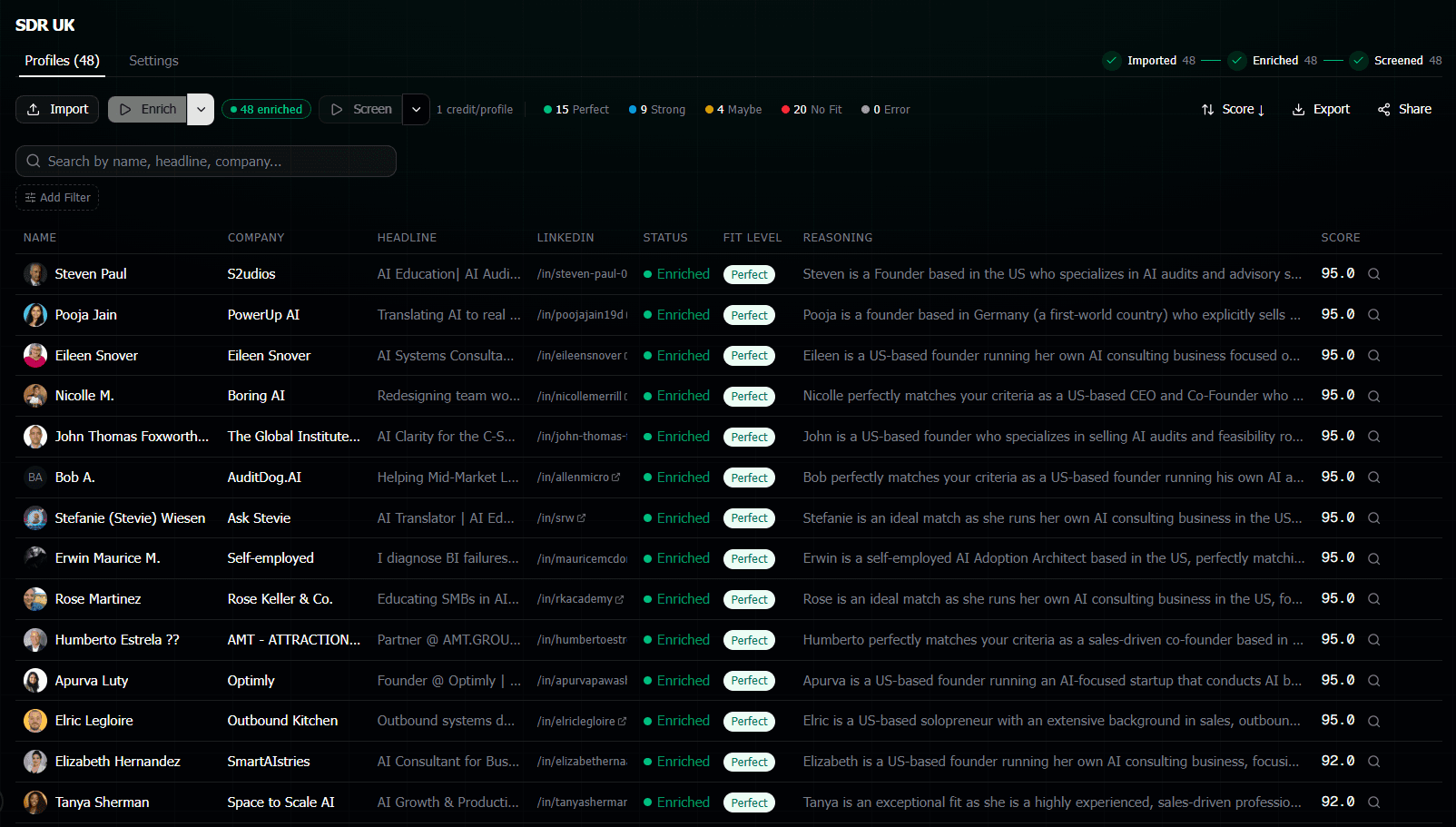
You get scored results with reasoning
Each candidate gets a 0-100 score and written reasoning explaining exactly why they matched (or didn't).
The Comparison That Matters
Let's put them next to each other honestly.
| Boolean Search | Natural Language Screening | |
|---|---|---|
| Learning curve | High. You need to learn syntax, operators, nesting. | None. Write like you talk. |
| Career context | Can't evaluate. Keyword-only. | Reads full career trajectory. |
| Title variations | You must list every synonym manually. | Understands equivalent roles automatically. |
| False positives | High. "Python" in a college project matches. | Low. Evaluates depth of experience. |
| Nuanced criteria | Impossible. Can't express "career growth" or "startup DNA." | Natural. Just describe it. |
| Output | A list of names. You still review manually. | Scored list with written reasoning for each. |
| Time per 300 profiles | 10+ hours (search + manual review). | ~5 minutes (AI reads and scores all). |
When Boolean Still Makes Sense
I'm not gonna pretend Boolean is useless in every situation. It still works fine for very simple, high-volume sourcing. "Find me everyone in San Francisco with the title Product Manager." Sure, Boolean handles that.
But the moment your criteria get even a little nuanced, Boolean starts breaking down. And for the evaluation step (actually deciding who's good), Boolean was never the right tool anyway.
The best workflow in 2026: use Boolean or LinkedIn Recruiter to build your initial candidate pool. Then use natural language AI screening to actually evaluate them. Sourcing and screening are two different jobs. Stop trying to make Boolean do both.
The Shift Is Already Happening
LinkedIn itself added AI-assisted search features. Every major ATS is bolting on AI. The industry is moving toward natural language because that's how humans actually think about candidates.
Nobody sits down with a hiring manager and says "I need (Python OR Go) AND (fintech OR payments)." You have a conversation. You describe the person. You talk about what matters.
Natural language screening just takes that conversation and turns it into an actual evaluation process. No translation to Boolean required.
Frequently Asked Questions
Do I need to stop using Boolean search completely?
No. Boolean is still fine for initial sourcing and building candidate lists. The argument here is about the screening step. Once you have a pool of candidates, natural language AI screening is way better than trying to filter them with Boolean strings or reviewing them one by one.
Is natural language screening less precise than Boolean?
Actually the opposite. Boolean gives you false precision. It matches exact keywords but misses context entirely. Natural language screening understands what you actually mean. Someone with "SDE II at Amazon" is a senior engineer even though the title doesn't say "senior." Boolean misses that. AI doesn't.
What if I write a vague prompt? Will the results be bad?
Garbage in, garbage out still applies. But the bar is way lower than Boolean. "Senior engineers who are good with Python" will give you decent results. The more specific you are, the better the results get. And unlike Boolean, you can add nuance without learning syntax.
Can I still filter by location, years of experience, etc.?
Yes. Just include it in your prompt. "Must be based in Europe, minimum 5 years experience, Python required." The AI treats those as hard requirements and evaluates everything else as preferences.
How does this work with Screener AI specifically?
You paste LinkedIn URLs (or upload a CSV), write your criteria in plain English, and get every candidate scored with reasoning in about 5 minutes. You can re-screen the same pool with different criteria for different roles. Try it free at screener.verumio.com.