Let me ask you something. Do you actually know how much it costs your team to screen candidates manually?
Not in some abstract "time is money" way. I mean the real dollar amount. Because when you actually do the math, it's kind of shocking.
Most recruiting teams have never calculated this. They just accept that screening takes forever and move on. But when you put actual numbers on it, you realize there's a massive leak in the budget that nobody talks about.
Let's Do the Math
Say you're hiring for a role and you've got 300 candidates to screen. Pretty standard number if you're sourcing properly.
A recruiter spends about 2 minutes per profile on average. Some are quick passes, some take 3-4 minutes when you're really reading. 2 minutes is generous.
The direct cost of screening 300 profiles manually
300 profiles x 2 minutes = 600 minutes = 10 hours. At $50-80/hr (loaded recruiter cost), that's $500 to $800. For one role. One batch of candidates. And that's just the screening step, not sourcing, not outreach, not scheduling.
Now multiply that across your open roles. If your team is screening for 10 roles this month, you're looking at $5,000 to $8,000 just in screening time. Per month. That's $60,000 to $96,000 a year spent on a recruiter clicking through profiles and reading.
And that's just one recruiter. Scale it to a team of 5 and you start to see numbers that would make any CFO uncomfortable.
But Wait. The Direct Cost Is the Small Part.
The $500-800 per role? That's just the obvious cost. The hidden costs are where it really gets painful.
Hidden cost #1: Quality degradation
Here's something every recruiter knows but rarely admits. Profile #10 gets a totally different evaluation than profile #250.
By hour 6, you're not really reading anymore. You're scanning for keywords. You're making snap judgments based on company names and titles. The nuanced evaluation you did for the first 50 candidates? Gone. You're running on fumes.
This means great candidates get rejected just because they were unlucky enough to be profile #237 when you were exhausted. You'll never know about the people you missed. That's the scariest part.
Hidden cost #2: Inconsistent criteria
Related to fatigue, but slightly different. Your standards literally shift during a screening session. After seeing 100 amazing candidates, a good-but-not-great candidate looks worse than they are. After 100 terrible candidates, a mediocre one looks like a star.
You end up with a shortlist that's basically random depending on what order you screened people in. That's not a process. That's a coin flip with extra steps.
Hidden cost #3: Slow time-to-fill
Every day a role stays open costs money. Industry estimates put it at $500 per day for a typical knowledge worker role (lost productivity, overloaded team members, delayed projects).
If manual screening adds 2-3 days to your process (which it easily does when you're juggling multiple roles), that's $1,000 to $1,500 in opportunity cost per role. Just from the screening bottleneck.
Hidden cost #4: Candidate experience
Top candidates are off the market in 10 days. That's the reality in 2026. If you're taking 3-5 days just to get through your screening pile before reaching out, the best people have already accepted other offers.
You're not just losing money. You're losing the candidates you most want to hire.
What About AI Screening? What Does That Cost?
Let's compare the same scenario. 300 candidates, same role.
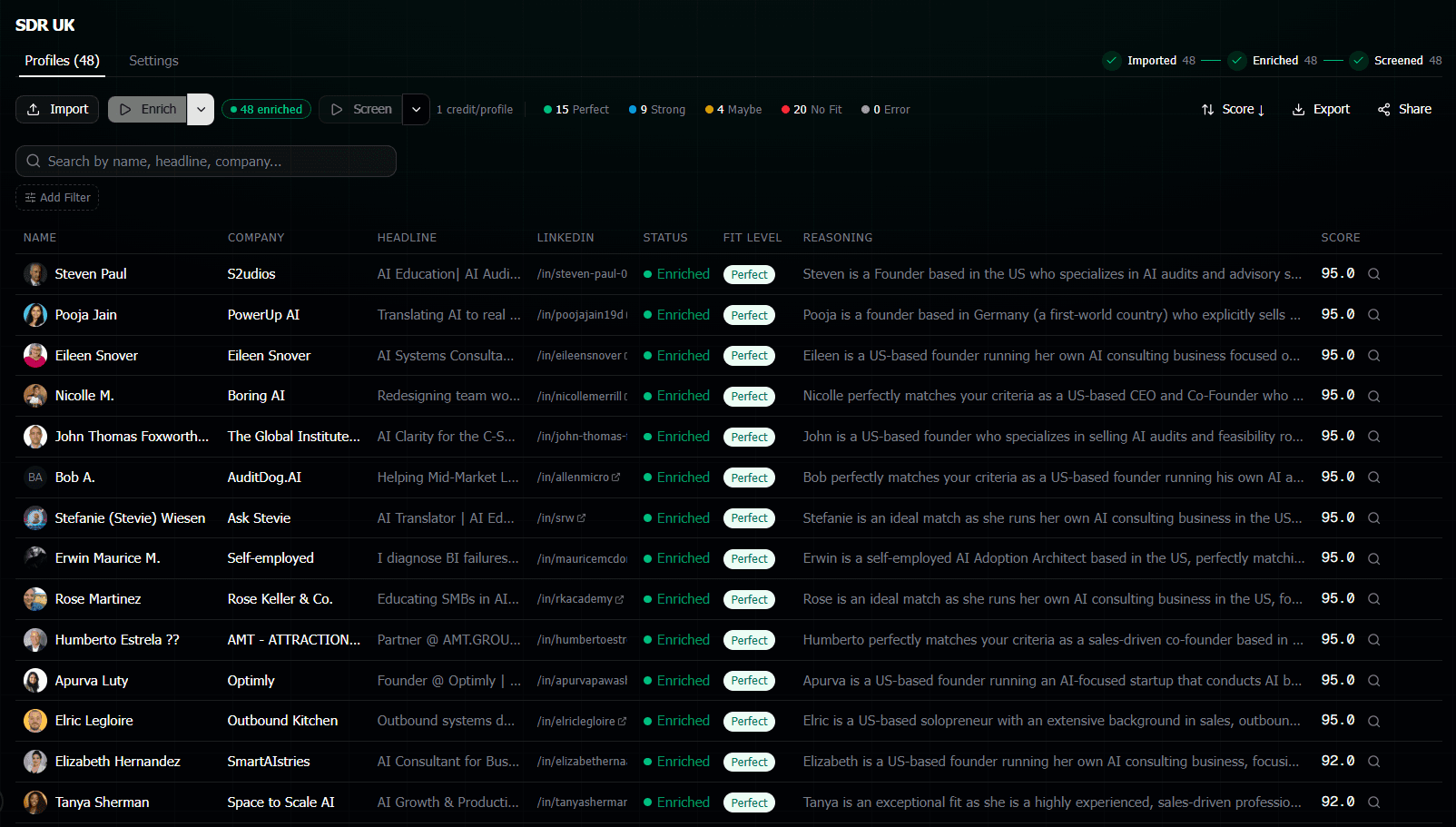
With AI screening, you paste your LinkedIn URLs, write what you're looking for in plain English, and hit go. The AI reads every single profile, evaluates them against your criteria, and gives you a scored shortlist with written reasoning.
Time: about 5 minutes. Your involvement: maybe 2 minutes writing the prompt, then reviewing the top 20-30 candidates.
The AI screening cost for 300 profiles
300 profiles x 2 credits each (enrich + screen) = 600 credits. On the Starter credit pack, that's roughly $17. Seventeen dollars. Compared to $500-800 in recruiter time.
Let me put that side by side so it really sinks in.
| Manual Screening | AI Screening | |
|---|---|---|
| Time | 10+ hours | ~5 minutes |
| Cost per 300 profiles | $500-800 (recruiter time) | ~$17 (credits) |
| Consistency | Degrades after ~50 profiles | Same criteria applied to every single profile |
| Output | A mental yes/no with no documentation | Score + fit level + written reasoning for each |
| Re-screening | Start over from scratch | New prompt, 2 more minutes |
| Monthly cost (10 roles) | $5,000-8,000 | ~$170 |
| Annual cost | $60,000-96,000 | ~$2,000 |
That annual difference is not a rounding error. It's a headcount.
The ROI Is Almost Embarrassing
Let's say you're a recruiter screening 10 roles a month with 300 candidates each. Conservative numbers for a busy team.
Manual cost: ~$6,500/month in your time.
AI screening cost: ~$170/month in credits.
That's a 97% reduction in screening cost. And you get those 100 hours back every month to actually talk to candidates, build relationships, and close hires. You know, the stuff that actually requires a human.
Where the real value is
It's not just about saving money on screening. It's about what your recruiters do with the 100 hours they get back. That's 100 hours of candidate engagement, hiring manager meetings, and pipeline building. The stuff that actually moves the needle.
But What About Quality?
This is the question that always comes up. "Sure it's fast and cheap, but is it any good?"
Here's the honest answer: the AI isn't making hiring decisions. It's giving you a first pass. Every candidate gets a score and written reasoning. You read the reasoning and make the final call.
But compare that to what actually happens during manual screening. After 200 profiles, are you really making quality decisions? Or are you just trying to get through the pile?
The AI applies the exact same criteria to profile #1 and profile #300. No fatigue. No bias drift. No "I'll just skim this one because I need lunch." That alone is a quality improvement for most teams.
The Real Business Case
If you need to convince someone (your boss, your CFO, yourself), here are the numbers that matter:
- Time saved: 10 hours per role, 100+ hours per month for an active recruiter
- Cost saved: $60,000-96,000 per year per recruiter (vs ~$2,000 in AI screening credits)
- Faster time-to-fill: Screen the same day you source, not 3-5 days later
- Better quality: Consistent evaluation across every candidate, not just the first 50
- Documentation: Every decision has written reasoning. Try doing that manually.
For a team of 5 recruiters, switching to AI screening is like getting a 6th recruiter for free. Actually, better than that, because the AI never has a bad day.
What This Looks Like in Practice
Here's the workflow that takes 10 hours down to 10 minutes:
Collect profiles
Paste LinkedIn URLs or upload a CSV. Takes 30 seconds.
Write your criteria
Describe what you want in plain English. Like texting a colleague. 1 minute.
AI screens everyone
Every profile gets read, evaluated, and scored. About 3-5 minutes for 300 profiles.
Review the top candidates
Read the reasoning for the top 20-30. Export or share with your client. 5 minutes.
Total: about 10 minutes of your time. $17 in credits. And you have a documented, reasoned shortlist you can share with anyone.
Frequently Asked Questions
Is $50-80/hr realistic for recruiter cost?
That's the loaded cost (salary + benefits + overhead), not just salary. A recruiter earning $70K salary actually costs the company $90-110K when you add benefits, tools, office space, and management overhead. That works out to roughly $50-60/hr. Senior recruiters at agencies easily hit $80/hr loaded cost.
What if I only screen 50 candidates per role, not 300?
The math still works. 50 profiles x 2 min = ~2 hours of screening time = $100-160 in recruiter cost. AI screening those 50 costs about $3. It's a smaller absolute number but the ratio is the same. And you might want to ask why you're only screening 50. Maybe you're limiting your pool because manual screening is too expensive, and AI screening would let you cast a wider net.
Does AI screening replace recruiters?
No, and that's the wrong way to think about it. It replaces the most tedious, lowest-value part of a recruiter's job. The profile-by-profile grind. It frees you up to do what humans are actually good at: building relationships, selling the opportunity, assessing culture fit in conversations. The stuff AI can't do.
What about the cost of getting it wrong? False negatives?
Every score comes with written reasoning. If you're worried about false negatives, check the low-scoring candidates and read why they scored low. Takes 2 minutes. Compare that to the false negatives from manual screening where you got tired at profile #200 and started auto-rejecting people.
How do I convince my team to try this?
Run a pilot. Take one role, screen the candidates manually AND with AI screening, and compare the results. The overlap will convince you. The candidates AI catches that you missed will really convince you. There are 50 free credits when you sign up at screener.verumio.com, so the pilot costs you nothing.