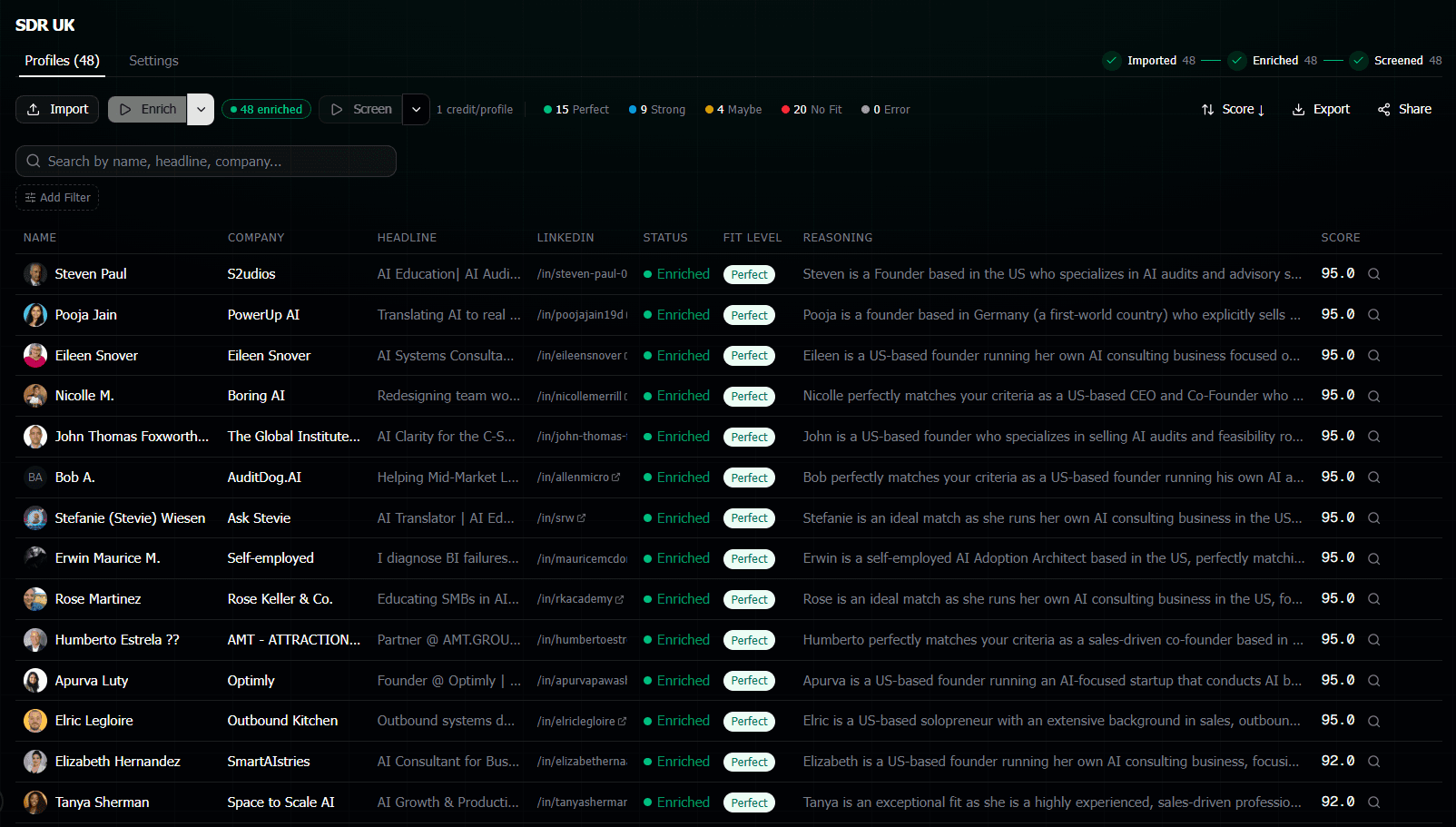
So you've got an AI screening tool. You paste in some LinkedIn URLs, write a prompt describing what you want, and it scores everyone. Cool.
But here's the thing nobody talks about: the quality of your results depends almost entirely on the quality of your prompt. Write a vague one and you'll get vague scores. Write a specific one and suddenly the AI is surfacing people you would've missed.
I've seen hundreds of screening prompts at this point. And the difference between a good one and a bad one is night and day. Let me show you what actually works.
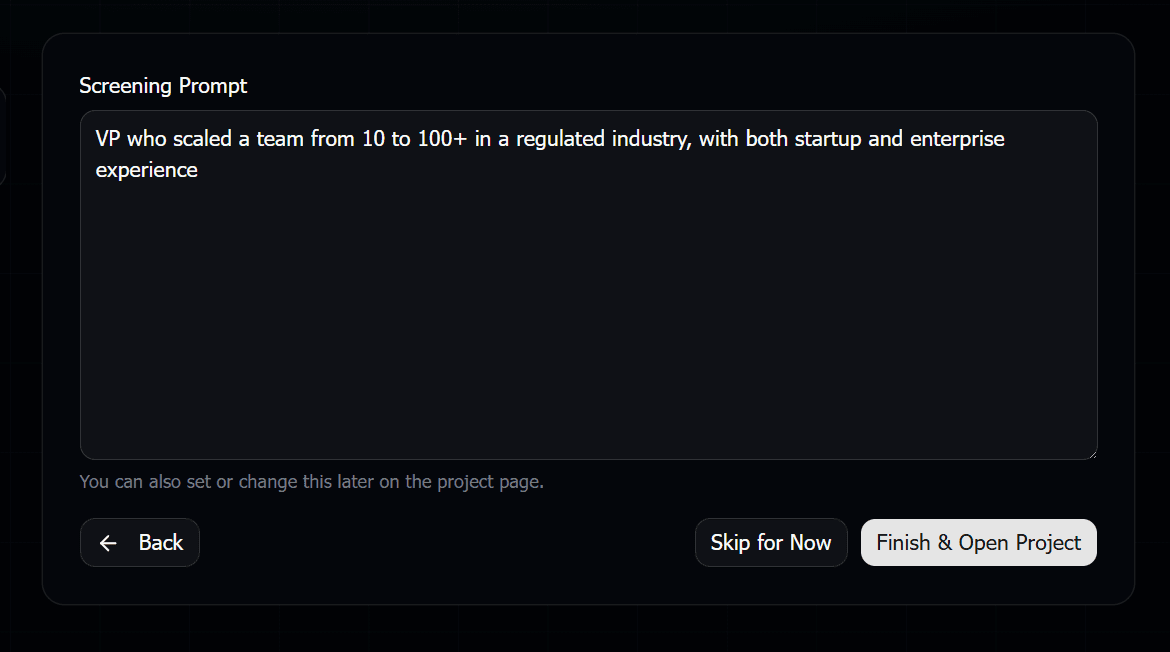
Why Your Screening Prompt Matters More Than You Think
With traditional filters, you pick from dropdowns. Years of experience. Location. Job title keywords. The tool does the rest. There's not much room for nuance.
AI screening is different. You're writing in natural language. Which means you can express things like "someone who's shown career growth" or "avoid people who bounce every 8 months." But it also means the AI is only as smart as what you tell it.
Think of it like briefing a really fast junior recruiter. If you say "find me good engineers," they'll bring you random engineers. If you say "find me backend engineers who've built payment systems at startups and are still hands-on ICs," you'll get exactly that.
The golden rule of screening prompts
If two recruiters could read your prompt and disagree on whether a candidate fits, your prompt isn't specific enough. The more precise you are, the more useful the AI's scores become.
What Makes a Bad Prompt (With Examples)
Let's start with what NOT to do. These are real patterns I see all the time.
Bad prompt #1: Too vague
Looking for a good software engineer with experience.
This tells the AI almost nothing. Good at what? Experience in what? What level? The AI will basically give everyone a middling score because it has nothing to differentiate on.
Bad prompt #2: Just a keyword list
Python, AWS, Docker, Kubernetes, microservices, CI/CD, agile.
This is basically Boolean search with extra steps. You're not using the AI's ability to understand context and career patterns. Someone could have all these keywords on their profile and still be totally wrong for your role.
Bad prompt #3: Copy-pasted job description
We are seeking a dynamic and results-oriented professional to join our innovative team. The ideal candidate will possess strong communication skills and a proven track record of delivering value in a fast-paced environment...
Job descriptions are written for candidates, not for evaluating them. They're full of filler words that don't help the AI distinguish a great fit from a mediocre one. Strip out the corporate speak and say what you actually mean.
Bad prompt #4: Discriminatory criteria
Young engineer, preferably from a top-tier university, no career gaps.
Besides being potentially illegal, this is just bad screening. Age, university prestige, and career gaps tell you almost nothing about whether someone can do the job. Focus on skills, experience, and career patterns that actually matter.
What Makes a Great Prompt
Great screening prompts share a few things in common. They're specific about what matters. They mention tradeoffs. They describe career patterns, not just skills. And they tell the AI what to prioritize when two candidates both look decent.
Here's what to include:
- Specific technical or domain skills that are actually required vs nice-to-have
- Career trajectory patterns you care about (growth, stability, leadership progression)
- Industry or company type preferences (startup vs enterprise, B2B vs B2C)
- What to deprioritizeso the AI knows what's a dealbreaker vs what's flexible
- Tradeoff guidance for when someone is strong in one area but weak in another
4 Real Screening Prompt Examples
Here are prompts I'd actually use for different roles. Feel free to steal and adapt them.
Example 1: Senior Backend Engineer (Fintech)
I need a senior backend engineer (5+ years) who's built production systems handling real money. Python or Go required, both is ideal. Strong preference for people who've worked at fast-growing fintech or payments companies (Stripe-level or Series B-D startups).
I want ICs who are still hands-on coding, not engineering managers who haven't written code in 2+ years. Distributed systems experience is a big plus. Career stability matters: if someone's had 4 jobs in 3 years, score them lower unless the moves clearly made sense (like acquisitions or company shutdowns).
If someone has amazing fintech experience but only knows Java instead of Python/Go, still score them reasonably. Languages can be learned. Domain expertise is harder to get.
See what this does? It gives the AI specific skills, company type preferences, career pattern guidance, AND a tradeoff to handle. The results from a prompt like this are dramatically better than "senior backend engineer, 5+ years, Python."
Example 2: VP of Sales (B2B SaaS)
Looking for a VP of Sales or Sales Director who's personally built and managed a team of 10+ salespeople at a B2B SaaS company. They need to have taken a company from roughly $2M ARR to $10M+ ARR, or shown similar growth at their segment level.
Strong preference for people who've sold into enterprise (not just SMB) and have experience with longer sales cycles (3-6 months). Industry doesn't matter much, but HR tech or recruiting tech is a bonus.
Red flags: people who've only been at massive companies where they inherited an existing team and playbook. I want builders. Also deprioritize anyone whose recent roles have been pure "strategy" or "advisory" without direct team management.
Notice the pattern?
Every good prompt describes what the person DID, not just what their title was. "VP of Sales" means nothing. "VP who built a team from 3 to 15 and grew revenue 5x" means everything.
Example 3: Product Manager (Growth / Consumer)
I need a product manager with 3-7 years experience who's worked on consumer-facing growth products. Think activation funnels, onboarding optimization, retention loops. Not enterprise PMs who manage feature roadmaps for big clients.
Ideal background: someone who's worked at a consumer app with 1M+ users and can point to specific metrics they moved. Bonus if they've worked with data/analytics teams closely and have some technical chops (SQL, experimentation frameworks).
I'd rather have someone from a smaller company where they owned the full product area than someone at a FAANG where they managed one button on one page. But FAANG experience plus a startup stint is the dream combo.
Example 4: Registered Nurse (ICU Experience)
Looking for registered nurses with at least 2 years of ICU or critical care experience. Active license required. BSN preferred over ADN, but ADN with strong ICU tenure is totally fine.
Strong preference for people who've worked at Level 1 or Level 2 trauma centers. CCRN certification is a nice bonus but not required. If someone has ER experience instead of ICU, that's still relevant but score them slightly lower.
Travel nurses are fine as long as their assignments show consistency in critical care. If they've bounced between med-surg, psych, and then one ICU assignment, that's less convincing than someone who's been in ICU consistently.
This shows it's not just for tech roles. Any role where you need to evaluate career patterns and credentials works great with AI screening.
Quick Tips for Better Prompts
Be specific about levels
"Senior" means different things at different companies. Say what you actually mean: "5-8 years, still coding daily, has mentored junior devs."
Include tradeoffs
Tell the AI what to do when someone is strong in X but weak in Y. This is where most prompts fall short.
Mention red flags
"Deprioritize job hoppers" or "lower score if they've only been in consulting" helps the AI filter more aggressively.
Iterate after first run
Read the reasoning on your first batch. If the AI is focusing on the wrong things, tweak the prompt and re-screen. It only takes a couple minutes.
Common Mistakes to Avoid
Don't ask for contradictions."10 years experience but early career energy" will confuse the scoring. Pick what actually matters.
Don't list 20 requirements.If everything is a "must-have," nothing is. The AI works best when it knows your top 3-4 priorities and can weigh the rest as bonuses.
Don't use internal jargon.The AI doesn't know what "Level 5" means at your company. Translate it to universal terms.
Don't forget to say what's flexible. "Python preferred but other languages acceptable" gives different results than "Python required." Be clear about dealbreakers vs preferences.
Frequently Asked Questions
How long should a screening prompt be?
Aim for 3-5 sentences minimum. Too short and the AI has nothing to differentiate on. Too long (like a full page) and priorities get diluted. The sweet spot is a paragraph or two that covers your must-haves, nice-to-haves, and one or two tradeoffs.
Can I use the same prompt for different batches of candidates?
Absolutely. That's one of the best parts. Write a great prompt once, then re-use it every time you get a new batch of profiles for the same role. You'll get consistent scoring across all batches.
What if the AI scores someone high that I disagree with?
Read the reasoning. If the AI focused on something you didn't care about, update your prompt to deprioritize that factor. If it misinterpreted your criteria, make the language more explicit. One or two iterations usually gets it dialed in.
Should I include salary or location requirements in the prompt?
Location can be useful if it's a hard requirement ("must be based in the EU for timezone overlap"). Salary is trickier since LinkedIn profiles rarely show salary expectations. Focus on skills, experience, and career patterns. Filter for salary during outreach.
Is it better to write one detailed prompt or run multiple focused ones?
One detailed prompt usually works best. But if you're hiring for a role where the must-haves are genuinely different across sub-categories (like a "full-stack engineer" where frontend and backend are equally valid), you could run two focused screens and compare. Re-screening the same profiles with a different prompt is cheap and fast.