If you've been in recruiting for more than five minutes in 2026, you've probably heard someone say "AI candidate scoring" and wondered what exactly that means. Is it a buzzword? Is it just keyword matching with a fancy name? Or is it actually useful?
Let me break it down simply. No jargon, no hype, just what it is and how it works.
What Is AI Candidate Scoring?
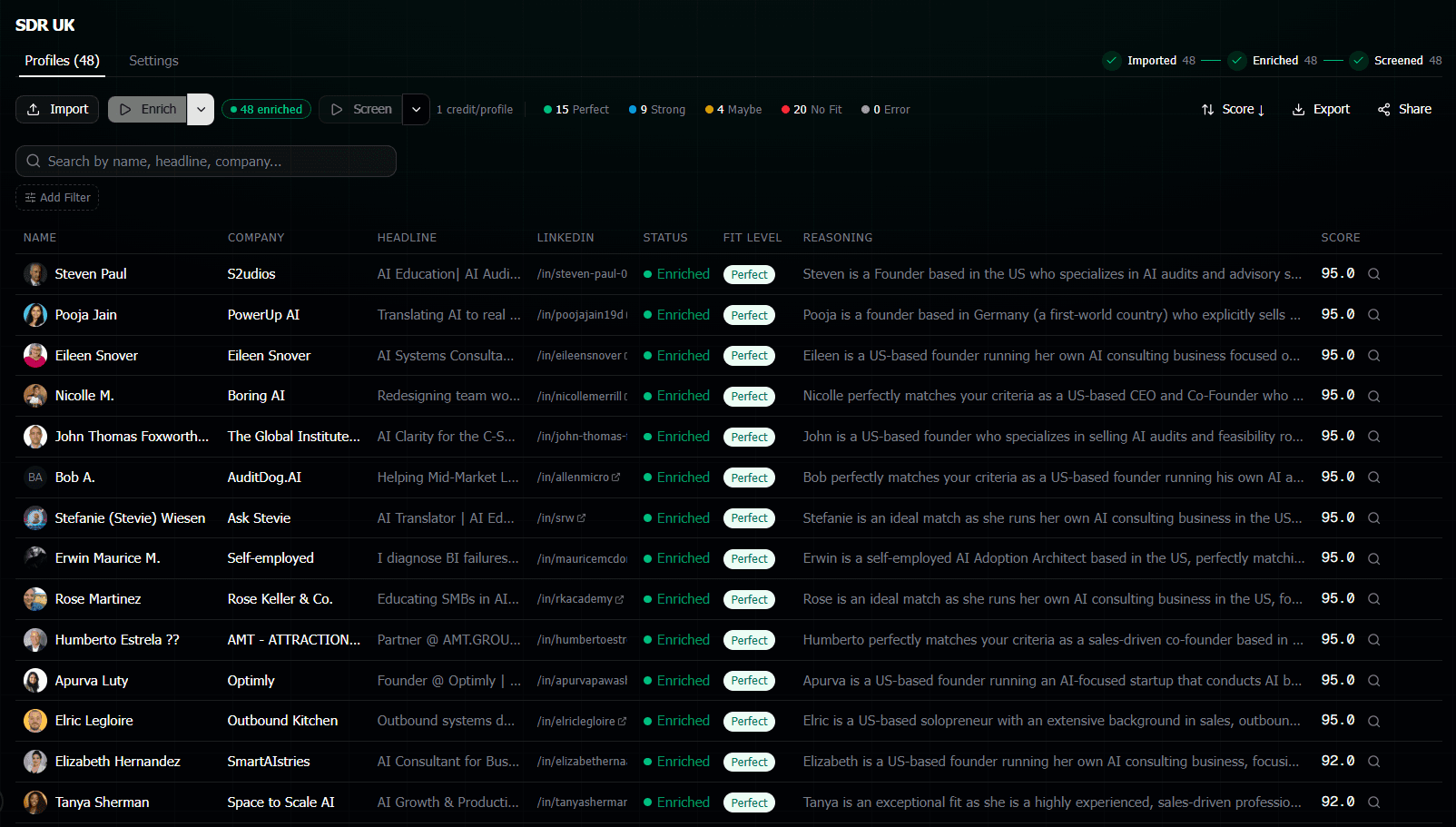
AI candidate scoring is when you give an AI system a description of what you're looking for in a candidate, it reads through each person's profile data, and it gives every candidate a score based on how well they match.
But the important part isn't the score. It's the reasoning. Good AI scoring tools don't just spit out a number. They tell you WHY someone got that score. Like "Strong match: 8 years of backend experience at two fintech companies, currently leading a team of 4. Only concern is no Go experience."
So you're not blindly trusting a number. You're reading a short summary of why the AI thinks this person fits (or doesn't) and deciding if you agree.
How Does It Actually Work?
The technical stuff is simpler than you'd think. Here's the basic flow:
Profile data gets collected
The tool pulls structured data from LinkedIn profiles: work history, job titles, companies, durations, education, skills. The raw material the AI needs to make a judgment.
You describe what you want
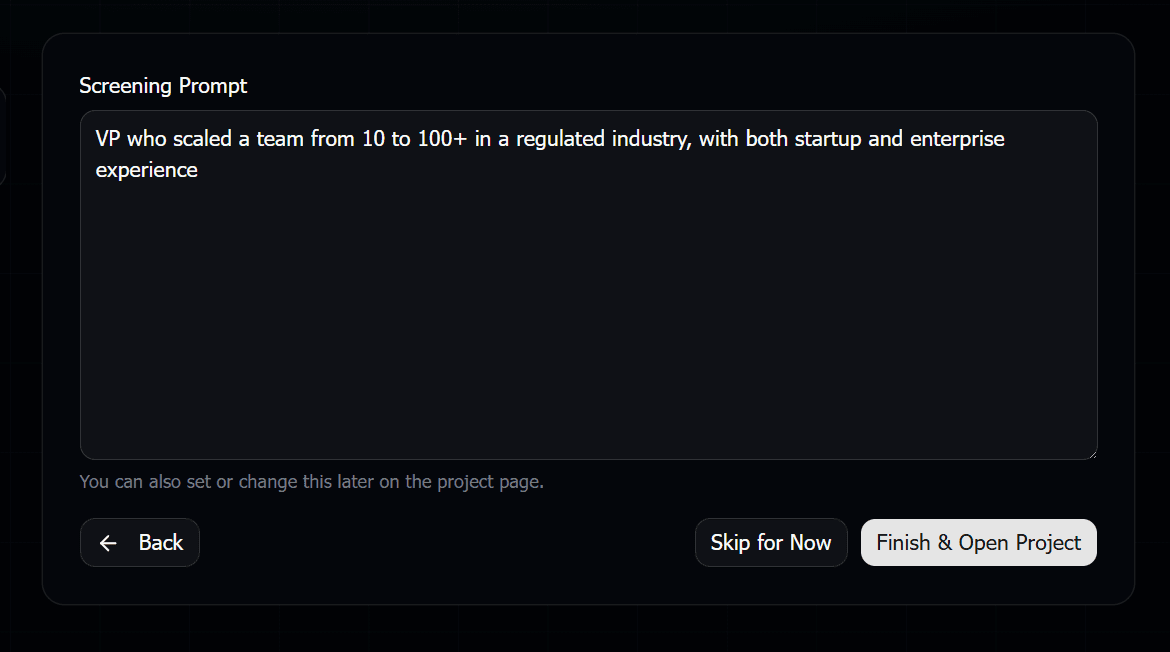
You write your screening criteria in plain English. Not checkboxes, not Boolean strings. Just describe your ideal candidate like you'd describe them to a colleague.
AI evaluates each profile
A large language model reads each profile against your criteria. It understands context, career trajectories, and nuance. Not just keyword matches.
You get scores + reasoning
Every candidate gets a score (0-100), a fit level (Perfect Fit, Strong Fit, Maybe, No Fit), and written reasoning you can read in seconds.
The magic is in step 3. Traditional tools match keywords. AI actually understands what a career trajectory looks like. It knows that a "Software Development Engineer" at Amazon is basically the same as a "Senior Backend Engineer" at a startup. It understands that going from IC to Tech Lead to Engineering Manager shows career growth.
Real Scoring Examples
Let's say you're screening for a Senior Product Manager with B2B SaaS experience and growth/activation focus. Here's what AI-scored results actually look like:
High score (87/100) - Strong Fit
Strong match. 6 years in product management across two B2B SaaS companies. Currently leading activation and onboarding at a Series C startup with 50K+ users. Previously owned the growth funnel at a mid-stage company where they grew trial-to-paid conversion by 40%. Has a data analytics background which aligns with the experimentation requirement. Only gap is no enterprise sales-led experience, but role is growth-focused so this is minor.
Medium score (52/100) - Maybe
Partial match. 4 years as a product manager, but primarily at an enterprise-focused company managing feature requests from large accounts. Some exposure to activation metrics but it wasn't their primary focus. Strong analytical skills and SQL proficiency. The B2B SaaS experience is there, but the growth/consumer-style product work is limited.
Low score (18/100) - No Fit
Poor match. Background is primarily in project management and operations, not product management. Current title is "Product Manager" but the role description and career history suggest project coordination rather than product ownership. No evidence of growth work, A/B testing, or activation funnel experience.
See how each score comes with a clear explanation? You don't have to guess why someone scored high or low. You read the reasoning, decide if you agree, and move on. Takes about 10 seconds per candidate instead of 2-3 minutes reading through their full profile.
AI Scoring vs Traditional Methods
Let's compare this to what most recruiters have been doing for years.
Manual review
You open each LinkedIn profile, read through it, make a gut call, move to the next one. It works fine for 20 profiles. It breaks down completely at 200. By profile 50, you're tired and skimming. Your criteria shifts without you noticing. You miss good people in the middle of the stack.
AI scoring advantage: Consistent criteria applied to every single profile, even at scale. No fatigue, no drift.
Keyword matching / Boolean search
You build a Boolean string like ("product manager" AND "B2B" AND "SaaS" AND "growth") and filter on it. You get results, but tons of false positives. Someone who mentioned "growth" once in their summary shows up next to someone who's been a growth PM for 5 years. They look the same to a keyword filter.
AI scoring advantage:Understands context, not just presence of keywords. It knows the difference between "mentioned growth" and "owns the growth funnel."
ATS scoring / resume parsing
Some applicant tracking systems have basic scoring features. They usually parse resumes for keywords and match against the job description. It's better than nothing but still pretty surface level. And it only works on applicants, not sourced candidates.
AI scoring advantage: Works on any LinkedIn profile, not just applicants. Evaluates career trajectory and context, not just keyword overlap.
The real shift
AI candidate scoring doesn't replace your judgment. It gives you the information you need to make faster, more informed decisions. You're still the one deciding who to contact. You're just not spending 10 hours reading profiles to get there.
What It Can and Can't Do
Let me be straight about the limitations because nobody else will.
It CAN:
- Read and evaluate hundreds of profiles in minutes
- Apply consistent criteria across every candidate
- Understand career patterns (growth, job hopping, specialization)
- Surface candidates you would've missed in a manual review
- Explain its reasoning so you can agree or override
It CANNOT:
- Evaluate soft skills, cultural fit, or personality (these require actual conversation)
- Read information that isn't on the LinkedIn profile
- Replace the interview process
- Guarantee a hire. It's a screening tool, not a crystal ball
Anyone telling you AI can fully automate hiring is selling you something. It's a time multiplier for the screening step. That's it. And that's already incredibly valuable.
How to Get Started
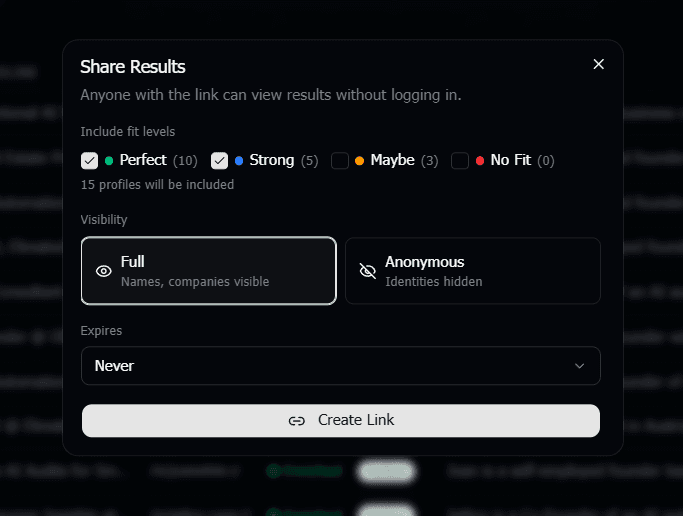
If you want to try AI candidate scoring, the barrier is pretty low. With Screener AI, you paste LinkedIn URLs, write what you're looking for, and get scored results in about 5 minutes. There are 50 free credits to test it on roughly 25 profiles before paying anything.
The key is writing a specific screening prompt. Don't just say "find me good engineers." Describe the career patterns, skill priorities, and tradeoffs you care about. The more you tell the AI, the better it scores. Check out our guide to writing great screening prompts for examples.
Frequently Asked Questions
Is AI candidate scoring biased?
AI scoring evaluates based on the criteria YOU write. It doesn't see photos, names, or demographics. It reads career history and skills data. That said, if your prompt contains biased criteria ("prefer candidates from elite universities"), the AI will follow that bias. Write fair criteria and you'll get fair scoring.
How accurate is AI candidate scoring compared to human review?
It's not about accuracy vs humans in a vacuum. It's about accuracy at scale. A recruiter carefully reviewing 20 profiles will probably make better judgments than AI. But that same recruiter on hour 6 of reviewing profile #180? The AI is more consistent. And every score comes with reasoning you can check, so you always have the final say.
Does AI candidate scoring work for non-tech roles?
Yes. It works for any role where LinkedIn profiles contain relevant career information. Sales, marketing, nursing, finance, operations, executive roles. As long as you can describe what you're looking for, the AI can evaluate against it.
Will AI scoring miss good candidates?
It can, especially if someone has a non-traditional background that doesn't match your criteria. But manual review misses candidates too, usually more of them because of fatigue. The difference is you can adjust your prompt and re-run the screen in 2 minutes if you think you're being too restrictive.
How is this different from LinkedIn Recruiter's AI features?
LinkedIn Recruiter's AI helps you find and sort candidates within LinkedIn's platform. AI candidate scoring evaluates candidates against your specific criteria with written reasoning. They solve different problems. Use Recruiter to build your candidate list, then use scoring to evaluate everyone at once instead of clicking through profiles one by one.